Original name Abram
Gen-17 God changes Abram’s name to Abraham - father of a multitude
Birth and Ancestors
- Timeframe: Approximately 2000-1800 BCE; born in the era of the patriarchs
- Place: Ur of the Chaldeans — Genesis 11:28
- Father: Terah (תֶּרַח) — Genesis 11:26
- Mother: Not named in scripture
- Sibling(s): Nahor (נָחוֹר) and Haran (הָרָן) — Genesis 11:26
- Hebrew Meaning of Name: Born Abram (אַבְרָם) — "exalted father"; renamed Abraham (אַבְרָהָם) by Yahweh — "father of a multitude" — Genesis 17:5
- Other Relatives of Note:
- Lot (לוֹט) — nephew, son of Haran — Genesis 11:27
- Milcah — niece, daughter of Haran, wife of Nahor — Genesis 11:29
- Laban — descendant through Nahor's line
- half brother of his wife, Sarah
Marriage and Descendants
- Spouse #1: Sarai/Sarah (שָׂרָה)
- Story: Sarai was married to Abram prior to the call to leave Ur — Gen-11:29Gen-11#v30-31 .
- She was barren — Genesis 11:30. She accompanied Abram to Canaan and Egypt.
- At age 90 Yahweh changed her name to Sarah and promised her a son — Genesis 17:15-16.
- She died at 127 years old in Kiriath-arba — Genesis 23:1-2
- Abraham and Sarah are depicted as a new Adam and Eve, who God is calling to return to the garden so he can bless all the nations through them.
- Children: Isaac (יִצְחָק) — Genesis 21:1-3
- Story: Sarai was married to Abram prior to the call to leave Ur — Gen-11:29Gen-11#v30-31 .
- Spouse #2: Hagar (הָגָר)
- Story: Egyptian handmaid of Sarah;
- given to Abram by Sarai as a surrogate — Genesis 16:1-3.
- After conceiving she despised Sarai and fled; the angel of Yahweh sent her back — Genesis 16:6-9.
- Later expelled with Ishmael at Sarah's insistence — Genesis 21:9-14.
- Yahweh provided water in the wilderness — Genesis 21:15-19
- Children: Ishmael (יִשְׁמָעֵאל) — Genesis 16:15
- Story: Egyptian handmaid of Sarah;
- Spouse #3: Keturah (קְטוּרָה) — married after Sarah's death — Genesis 25:1
- Other Descendants of Note:
- Jacob and Esau through Isaac — Genesis 25:19-26
- The twelve tribes of Israel through Jacob
- Midianites through Midian — connected to Moses' father-in-law Jethro
Land and Dwelling
- Ur of the Chaldeans — birthplace — Genesis 11:28
- Haran — settled there with Terah until Terah's death — Genesis 11:31-32
- Shechem/Canaan — first stop after the call; built an altar — Genesis 12:6-7
- Bethel — built an altar — Genesis 12:8
- Egypt — sojourned during famine — Genesis 12:10
- Negev — Genesis 12:9; 13:1
- Hebron/Mamre — primary dwelling in Canaan; settled near the oaks of Mamre — Genesis 13:18; 18:1
- Beersheba — dwelt there after the binding of Isaac — Genesis 22:19
Journeys
- God spoke to Abraham (https://www.gotquestions.org/life-Abraham.html) several times. Many of their conversations were filled with instruction, but God also gave Abraham glimpses of the future. In fact, in their first meeting, God started by telling Abram (75 yrs) to leave his country and travel to a new place (Genesis 12:1 (https://biblia.com/bible/esv/Gen 12.1)) and then went straight into a blessing that doubled as a prophecy of the future (Genesis 12:2–3 (https://biblia.com/bible/esv/Gen 12.2–3)).
- Ur → Haran — Genesis 11:31
- Haran → Canaan — the call of Yahweh — Genesis 12:1-5
- Canaan → Egypt → Negev — famine journey — Genesis 12:10-13:1
- Rescue of Lot — pursued kings as far as Dan and Hobah north of Damascus — Genesis 14:14-15
- Canaan → Moriah — the binding of Isaac — Genesis 22:1-19
Maps
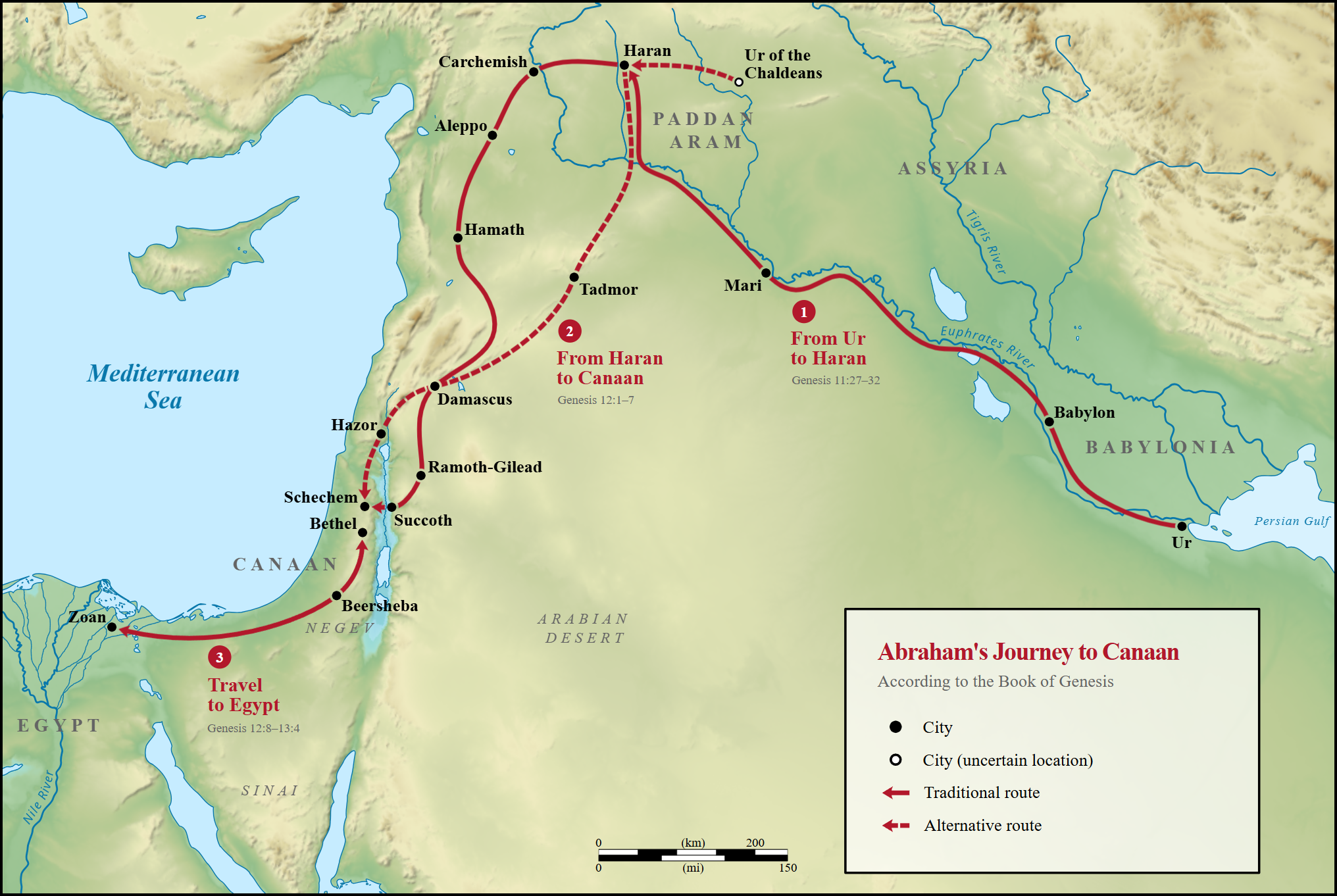
Occupation and Military
- Patriarch and herdsman — great wealth in livestock, silver and gold — Genesis 13:2
- Commanded 318 trained men born in his household — Genesis 14:14; capable military leader
- Defeated the coalition of four kings to rescue Lot — Gen-14:1Gen-14#v2Gen-14#v3Gen-14#v4Gen-14#v5Gen-14#v6Gen-14#v7Gen-14#v8Gen-14#v9Gen-14#v10Gen-14#v11Gen-14#v12Gen-14#v13Gen-14#v14Gen-14#v15-16
Medical and Death
- Both he and Sarah considered their bodies as good as dead regarding conception — Romans 4:19
- Died at 175 years old — Genesis 25:7
- Buried by Isaac and Ishmael in the cave of Machpelah, the field of Ephron, before Mamre — Genesis 25:9
- Secular Year -1638
- Jewish Year 2123
- Genesis 25:7-10
Righteousness and Unrighteousness
Righteousness
- His belief in God’s promise is counted as righteousness (Genesis 15:6), and his obedience, especially in the near-sacrifice of Isaac, underscores his devotion.
- Called by Yahweh out of Ur — Genesis 12:1; Nehemiah 9:7
- Believed Yahweh and it was credited to him as righteousness — Genesis 15:6; Romans 4:3; Galatians 3:6; James 2:23
- Interceded for Sodom and Lot — Genesis 18:23-32
- Obeyed the call to sacrifice Isaac without recorded hesitation — Genesis 22:1-10; Hebrews 11:17-19
- Paid tithes to Melchizedek — Genesis 14:20; Hebrews 7:2
- Called friend of Yahweh — 2 Chronicles 20:7; Isaiah 41:8; James 2:23
- Kept Yahweh's charge, commandments, statutes and laws — Genesis 26:5
Unrighteousness
- Twice deceived about Sarai being his wife rather than his wife — Genesis 12:11-13; 20:2; risking her being taken by another man
- Listened to Sarai's voice regarding Hagar rather than waiting on Yahweh's promise — Genesis 16:2
- Expelled Hagar and Ishmael at Sarah's insistence, though Yahweh permitted it — Genesis 21:9-14
Connections
| file.inlinks |
|---|
Other
Abrahamic Covenant
- In Genesis 12:2-3, God promises to bless Abram, make him a great nation, and bless all families of the earth through him.
- In Genesis 15, God reaffirms the promise of numerous offspring and land, sealing it with a covenant ceremony. When Abram believes God, it is “counted to him as righteousness” (Genesis 15:6), a key verse cited in Romans 4:3 and Galatians 3:6 to highlight his faith.
- In Genesis 17, God changes Abram’s name to Abraham (“father of a multitude”) and establishes circumcision as the covenant sign. God promises Abraham a son through Sarah, Isaac, and that his descendants will possess Canaan.
- In Genesis 22:15-18, after Abraham’s willingness to sacrifice Isaac, God reiterates the promise, emphasizing that all nations will be blessed through his offspring.
- Melchizedek blessed Abram and Abram gave him a tenth — Genesis 14:18-20
- Received the covenant of Circumcision — Genesis 17:9-14
- Three visitors appeared at Mamre; Abraham interceded for Sodom — Genesis 18
- Father of faith in both Jewish and NT understanding — Romans 4; Galatians 3; Hebrews 11
- The land covenant given to his descendants — Genesis 15:18-21
Events in History
- Egypt: In Genesis 12:10-20, due to famine, Abraham goes to Egypt and, fearing for his life, asks Sarai to say she is his sister. Pharaoh takes her but is afflicted by God, and Abraham leaves with wealth after the truth is revealed. A similar incident occurs with Abimelech in Genesis 20.
- Lot’s Separation: In Genesis 13, Abraham and Lot separate due to land disputes. Abraham generously lets Lot choose first, and Lot picks the Jordan Valley. God then reaffirms the land promise to Abraham.
- Rescue of Lot: In Genesis 14, Abraham defeats kings who captured Lot, showing his leadership and bravery. He meets Melchizedek, priest-king of Salem, who blesses him, and Abraham gives him a tithe.
- Hagar and Ishmael: In Genesis 16, impatient for an heir, Abraham, at Sarai’s urging, fathers Ishmael through Hagar, Sarai’s servant. God later blesses Ishmael but clarifies Isaac as the covenant heir (Genesis 17:19-21).
- Sodom and Gomorrah: In Genesis 18-19, Abraham intercedes with God to spare Sodom, showing his compassion and boldness. God destroys the cities but spares Lot.
- Isaac’s Birth and Sacrifice: In Genesis 21, Sarah bears Isaac, the promised son. In Genesis 22, God tests Abraham by commanding him to sacrifice Isaac. Abraham obeys but is stopped by God, who provides a ram instead, affirming Abraham’s faith.
- Sarah’s Death and Burial: In Genesis 23, Abraham mourns Sarah’s death and purchases the cave of Machpelah to bury her, securing a foothold in Canaan.
- Keturah and Later Life: In Genesis 25:1-6, Abraham marries Keturah, who bears six sons. He sends their descendants away with gifts, ensuring Isaac’s inheritance. Abraham dies at 175 (Genesis 25:7-8) and is buried with Sarah.
Charts
| Secular Year | Jewish Year | Event in History |
|---|---|---|
| -1813 | 1948 | Abraham (son of Terah) was born (https://www.chabad.org/library/article_cdo/aid/112356/jewish/Who-Was-Abraham-The-First-Patriarch-in-the-Bible.htm) |
| -1803 | 1958 | Sarah (daughter of Haran) was born (https://www.chabad.org/library/article_cdo/aid/112508/jewish/Sarah-of-the-Bible-The-First-Matriarch.htm) |
| -1788 | 1973 | Abraham married Sarah (https://www.chabad.org/library/article_cdo/aid/112356/jewish/Who-Was-Abraham-The-First-Patriarch-in-the-Bible.htm) |
| -1765 | 1996 | Dispersion from Babel after building the tower (https://www.chabad.org/library/article_cdo/aid/246611/jewish/The-Tower-Of-Babel.htm) |
| -1761 | 2000 | Terah Terah left Ur Kasdim with his family |
| -1755 | 2006 | Noah Noah died |
Diagrams
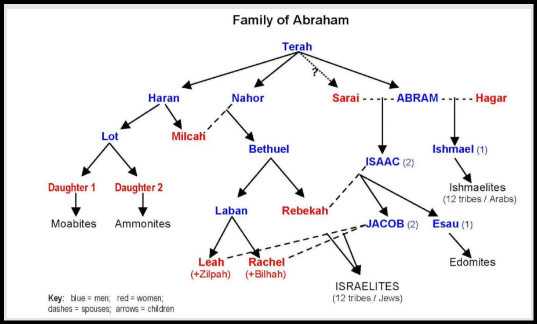
Extra Biblical Information
Landmarks
- Cave of Machpelah — located in modern-day Hebron (Al-Khalil), West Bank; the site is covered by the Ibrahimi Mosque/Cave of the Patriarchs, one of the oldest continuously used religious sites in the world
- Ur of the Chaldeans — identified with Tell el-Muqayyar in modern southern Iraq near Nasiriyah
- Oak of Mamre — traditionally located near Hebron; a site venerated in antiquity
Archaeology
- Ur excavations — Sir Leonard Woolley's excavations (1922-1934) uncovered a sophisticated urban center consistent with the biblical description of Ur; royal tombs and ziggurat remains discovered
- Nuzi Tablets — ancient texts from Nuzi (modern Iraq) reflect customs consistent with the patriarchal narratives including surrogate wife arrangements and inheritance customs matching the Hagar/Sarai account
- Ebla Tablets — discovered in Syria (1974-1975); reference cities and customs consistent with the patriarchal period, lending support to the historical plausibility of the Genesis accounts