Sons of God
Sons of God - Malʾak
Connections
NOTES
BIBLE PROJECT CLASSROOM SOURCE: HANDOUTS
R ank term associated with the royal court.
T im Mackie = always refers to spiritual beings in God’s heveanly court/realm. They are called Genesis 1 Host of the Skys.
T he opposite is the Son of Man.
T he phrase “sons of Elohim ” (אלהיםבני) is used five times in the Hebrew Bible, and it always refers to spiritual beings who inhabit the divine realm in God’s presence, otherwise known as the divine council.
T he meaning of “sons of ” or “daughters of”In Hebrew, the plural phrase “sons of” is a figure of speech that means “members of the class /group of.”
G enesis 6:1 draws such a strong contrast between the “daugh-ters of humanity” and the “sons of Elohim.” The point at issue is the violation of boundaries between human and divine.
Did the Sons of Elohim Actually Have Sex with Human Women?
T he plain sense meaning of this story is fairly clear: yes, these spiritual beings crossed the Heaven and Earth boundary and had sex with women.
- T he phrase “and they took women for themselves” is a standard biblical Hebrew phrase for sexual intercourse, including illicit sex (see Genesis 38:2; Leviticus 18: 17; Leviticus 20: 17).
- W hen spiritual beings are sent on missions in the earthly realm, they are called by a functional title, malakim in Hebrew, and in Greek, angelos, that is, “ angels.” In the story of the Bible, angels regularly take on a human appearance and interact with humans in a physical way. They can walk with people, and have meals (see Genesis 18:1 - 5), and wrestle with them as well (see Genesis 32: 23-32)
- T his cosmic cross-species sexual encounter is reinforced by the presence of a narrative design pattern used by the author, who connects Genesis 6:1 - 4 with Genesis 3:1 - 7.
G enesis 3:6; Genesis 2: 24-25; Genesis 6:1 - 2; Genesis 6:3 connection:
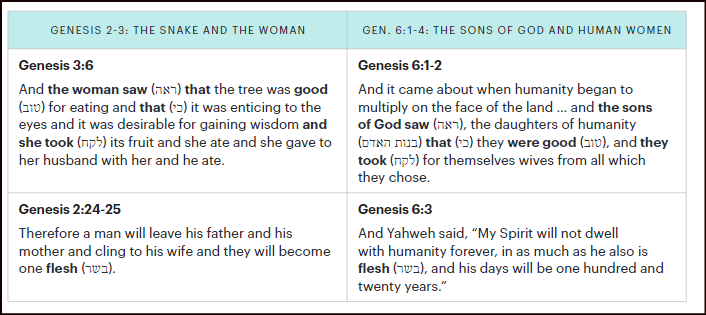
Heiser, Michael S.. The Unseen Realm: Recovering the Supernatural Worldview of the Bible. Lexham Press. Kindle Edition.
Yahweh is at the top.2 His family-household (“sons of God”) are next in hierarchy. The lowest level is reserved for elohim messengers—mal’akim (the word translated “angels”).
Malʾak
NOTES
Heiser, Michael S.. The Unseen Realm: Recovering the Supernatural Worldview of the Bible (p. 369). Lexham Press. Kindle Edition.
I n the ancient Semitic world, sons of God (Hebrew: beney elohim) is a phrase used to identify divine beings with higher-level responsibilities or jurisdictions. The term angel (Hebrew: malʾak) describes an important but still lesser task: delivering messages.2
T here are roughly 175 references to Angel in the New Testament (aggelos/angelos). Like the Hebrew counterpart (malʾak), the term means “ messenger.” Fundamentally, the term describes a task performed