Notes of 14th of Nisan
See also The Week of Passover
Notes regarding when Passover was celebrated:
chapter-seventeen-later-passover-practices-as-recorded-by-jewish-historians
The book of Ezra records the first Passover to be observed after the dedication of the second temple. Although the Passover was centered at the temple, the lambs were slain at the beginning of the 14th and were eaten on the night of the 14th (Ezra 6:19-21).
In later temple-centered observances, the lambs were slain late on the 14th and were not eaten until the night of the 15th. Although the temple sacrifice in the afternoon of the 14th became a widespread tradition, it did not wholly replace the domestic sacrifice of the lambs at the beginning of the 14th. Some Jews continued to observe the domestic Passover as commanded in the Scriptures, and others kept the temple-centered Passover as sanctioned by the religious authorities. The records of Scripture and history show that the two practices existed side by side.
It is important to understand that Ezra’s decree did not change the time for killing the Passover lambs. His Passover law did not in any way alter or contradict the Passover ordinances of God, as recorded in Scripture. The measures that Ezra enforced were aimed at protecting the true worship of God and upholding His laws—not changing or replacing them. His restriction of the Passover to the area of Jerusalem promoted a temple centered observance, but it did not replace or prohibit the domestic killing of the Passover within that area.
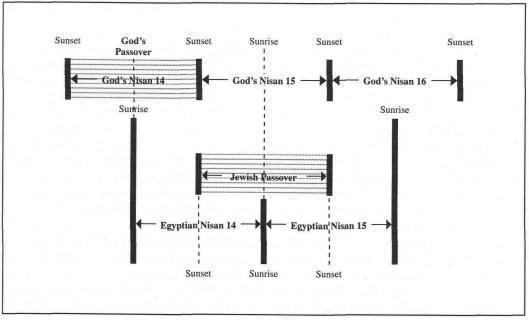
For those Jews who reckoned the day from sunrise to sunrise, the 14th day of the first month began twelve hours later than by Scriptural reckoning. The Jews who kept the Passover at this later time were actually observing the 15th, according to Scriptural reckoning, although it was designated as the 14th day of the month by Egyptian reckoning. After the Egyptian domination ended, the Jews went back to reckoning the day from sunset to sunset, but the influence of the Egyptian practice had a lasting effect by contributing to the development of a 15th Passover.
Historical information provided by Philo indicates that it was more widely observed among the Jews in New Testament times than was the temple sacrifice of the Passover. Philo’s records give us firm historical evidence that at the time of Jesus, and shortly after, there was widespread observance of the domestic Passover. Although the domestic Passover was the prevailing practice in New Testament times, the temple sacrifice of the Passover was firmly established among the Pharisaic Jews. The Pharisees observed a 14/15 Passover, taking their lambs to the temple to be sacrificed on the afternoon of the 14th and eating their Passover meal on the 15th. The temple sacrifice of the Passover, as observed by the Pharisaic Jews, later became an official tradition of Judaism. This tradition was practiced until the destruction of the temple in AD 70. Some claim that Jesus and His disciples conformed to the traditional temple sacrifice of the Passover. But the New Testament records that Jesus kept the Passover the night before the traditional temple observance. The Gospel accounts of His last Passover make it abundantly clear that it was a domestic observance on the night of the 14th. The disciples Peter and John were commanded by Jesus to prepare a Passover lamb that was killed at the house, or inn, where they kept the Passover (Luke 22:8). Based on the Gospel records, we can conclude that the domestic sacrifice of the Passover and the temple sacrifice of the Passover were existing side by side.
Connections
| file.inlinks |
|---|